Are Your Exhibit Assets Working As Hard As You Are?

Why exhibit companies and event program managers are turning to smarter asset management and what it means for your bottom line.
You've invested hundreds of thousands, sometimes millions of dollars in trade show booths, display systems, graphics, promotional assets, brand activations and event infrastructure. But if you're like most exhibit companies and corporate event teams, you probably can't answer these questions off the top of your head:
• Where is that 20x20 island booth right now and is it available for next month's show?
• Which assets are sitting idle in a warehouse, quietly depreciating?
• How much did you spend on emergency replacement graphics last quarter because nobody knew the originals were damaged?
If those questions are uncomfortable to answer, you're not alone. And you're not without options.
The Hidden Cost of "Good Enough" Asset Management
For exhibit companies and event program managers, the operational stakes are high. A missed asset, a last-minute freight scramble or a miscommunication between the warehouse, client or event rep, doesn't just create stress, it creates real financial loss.
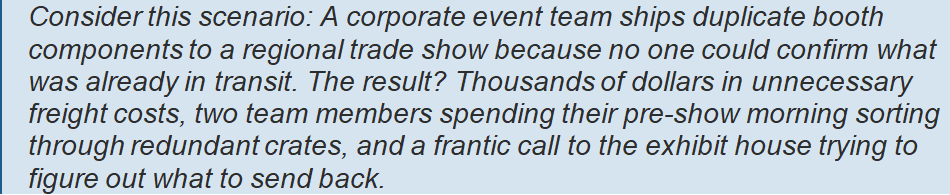
This isn't a failure of effort. It's a failure of visibility. And it happens constantly across the events industry at exhibit companies managing dozens of client event programs simultaneously and with enterprise marketing teams running event portfolios and brand activations across multiple regions.
The terminology your teams use to describe, track, and communicate about event assets directly affects operational outcomes. When your account manager calls something a "kit" and your warehouse team calls it a "property," things get missed. When your client's marketing team doesn't understand what "drayage" covers, budgets blow up on-site.
Getting aligned on the language of exhibit asset management isn't a nice-to-have. It's the foundation of a program that runs smoothly and scales.
The Language of Exhibit Asset Management - And Why It Matters

The events industry has its own language and vocabulary and the gap between how different event teams and departments use that vocabulary creates friction at every stage of the event lifecycle. Here are some of the terms that are common in the events and exhibit industry:
Asset Utilization Rate
How often is an asset being used relative to how often it could be? Low utilization is often invisible, until someone builds a financial case for a capital purchase that turns out to be completely unnecessary. Exhibit houses that track asset utilization rate can offer clients smarter recommendations: don't buy a second booth, rent ours for the three shows a year you need it.
Asset Lifecycle Management
From the day an asset enters your inventory to the day it's retired, every stage has a cost and an opportunity. Event teams that actively manage asset lifecycle reduce unplanned replacement costs, optimize maintenance schedules and make smarter capital decisions. Event teams that don't, end up surprised by a booth that's technically "available" but structurally unsound.
Drayage
The transport of your event asset and materials from a venue's loading dock to your booth space, handled by the official show vendor, priced by weight and non-negotiable on-site. For clients who've never attended a major trade show, this line item can be a shock. For exhibit houses, proactively educating clients on drayage (and designing lighter, smarter exhibits to reduce it) is a real competitive differentiator.
Advance Warehouse
Shipping directly to a show site sounds efficient, until your crates arrive before the venue opens, sit outside and get hit with surcharges. The advance warehouse is a staging facility near the venue used to receive, inspect and prepare assets ahead of the show. Knowing when and how to route shipments through an advance warehouse saves money and reduces on-site scrambles.
Inventory Reconciliation
Comparing what your system says you have against what's actually on the shelf. In a high-volume exhibit environment, discrepancies are common and costly. A missing graphic panel discovered the night before installation is a very different problem than one discovered during a warehouse audit two weeks out.
What SaaS Technology Actually Changes

The events and exhibit asset management space has moved well beyond spreadsheets, emails and whiteboard grids. Modern cloud-based SaaS platforms are giving both exhibit companies and corporate event teams capabilities that were simply out of reach 10 years ago and they're reshaping how successful event programs are run and how they scale.
Real-Time Asset Visibility
Real-time asset visibility now makes it possible to know exactly where an asset is, in your warehouse, in transit or on a show floor at any moment. For exhibit companies managing multiple client accounts, this eliminates the "where is it?" call. For corporate teams with assets deployed across five cities, it eliminates the guesswork.
Centralized Inventory Dashboards
When your event account manager, your warehouse team, your logistics coordinator and your client all have access to the same real-time inventory view, the number of miscommunications drops dramatically. Centralized dashboards consolidate data from multiple events and locations into a single source of truth, so no one is working from a spreadsheet or email that was accurate three days ago.
ERP and CRM Integration
For enterprise event programs, asset management data doesn't live in isolation it connects to financial reporting, procurement cycles and budget planning. Platforms that integrate with ERP systems allow event teams to tie asset depreciation, maintenance costs and utilization rates directly to program ROI. That's a conversation your CFO can get behind.
Cloud-Based Access, Cybersecurity and Permission-Based Roles
The shift to cloud-based asset management platforms has fundamentally changed who can access program data and when. For exhibit companies managing multiple client accounts and for large organizations running event programs across regions or business units, this isn’t just a convenience feature. It’s a structural advantage.
Cloud access means your warehouse manager in Chicago, your account lead in Dallas, and your client’s marketing director in New York are all working from the same live data without emailing spreadsheets back and forth or waiting for someone to “update the master file.” When a crate is checked in, a graphic is flagged as damaged, or an asset is reserved for an upcoming show, everyone who needs to know sees it immediately. That kind of real-time alignment across distributed teams is what separates programs that run smoothly from programs that are constantly putting out fires.
But access and security go hand in hand. For enterprise organizations, trade show programs often involve sensitive data, supplier contracts, client asset valuations, event budgets and proprietary booth designs. A platform with robust cybersecurity infrastructure, including encrypted data transmission and secure cloud hosting ensures that information is protected at every level. For exhibit companies handling assets on behalf of multiple clients, that security posture is not just a technical detail. It’s a trust signal and increasingly, a requirement in vendor selection conversations.
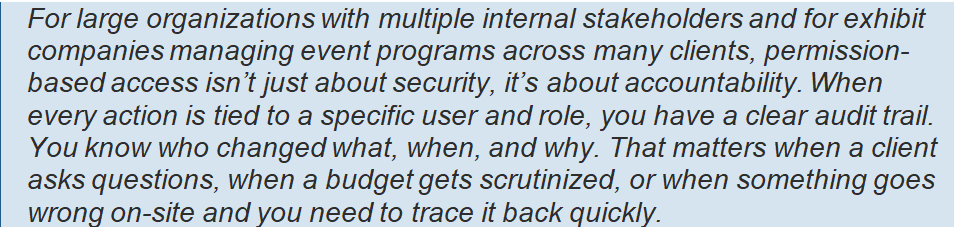
Permission-based role management takes this a step further. Not everyone in your organization needs access to everything and in a well-run program, they shouldn’t have it. Leading platforms allow administrators to assign granular access by role: a warehouse technician can check assets in and out but can’t modify financial records; a client can view their own program inventory but not a competitor’s; a regional event coordinator can request asset allocations but can’t override a reservation made by another team. This structure eliminates a significant source of operational error, the accidental override, the unauthorized change, the well-meaning edit that breaks something upstream.
Two Programs, One Set of Problems
The challenges of exhibit asset management look slightly different depending on where you sit, but they're more similar than you might think.
For Exhibit Houses:
Your business is built on delivering for clients, reliably, efficiently and profitably. Every untracked asset is a liability. Every warehouse inefficiency is margin erosion. Every last-minute logistics scramble is a risk to the client relationship. The exhibit companies winning right now are the ones who can walk into a client meeting and show exactly how their event program is performing, utilization rates, asset health scores, cost-per-show metrics because they have the data to back it up.
For Corporate Event Program Managers:
You're being asked to do more with the same budget, or less. The pressure to demonstrate event ROI is higher than ever. But if you can't tell your leadership team what your assets are worth, how often they're being used or what it costs to run a show, you're fighting that battle with one hand tied behind your back. Exhibit asset management software gives you the reporting infrastructure to make that case and the operational visibility to stop money from slipping through the cracks.
What to Look for in an Exhibit Asset Management Platform

Not all SaaS exhibit asset management platforms are built equally and the wrong tool can create more administrative burden than it solves. When evaluating solutions, the features that matter most are:
• Real-time asset tracking
• Centralized inventory and ordering management across multiple locations, warehouses and client accounts
• Asset lifecycle tracking from acquisition through retirement
• Shipping manifest generation and logistics workflow automation
• Utilization reporting and ROI measurement by event or program
• ERP integration for financial oversight and depreciation tracking
• Cybersecurity and permission-based roles
• A SaaS exhibit asset management platform that scales with your business growth
The right platform should reduce the administrative burden on your team, not add to it. If your people are spending more time managing the software than managing the program, something is wrong.
The Bottom Line
The events industry is competitive and complex. Whether you're an exhibit company trying to protect your margins, strengthen client relationships and scale your events program or a corporate event manager trying to justify your program's ROI, the answer is the same:

Exhibit asset management SaaS solutions isn't a back-office function. It's a strategic capability. And the exhibit companies and organizations that treat it that way are the ones running better event programs, retaining more clients and making smarter investments.
If you're ready to see what that looks like for your events program and how you’d like to scale your operations, the conversation starts with a 30-minute discovery call. Let's look at your current workflow and show you exactly where the gaps are and what it would mean to close them.